
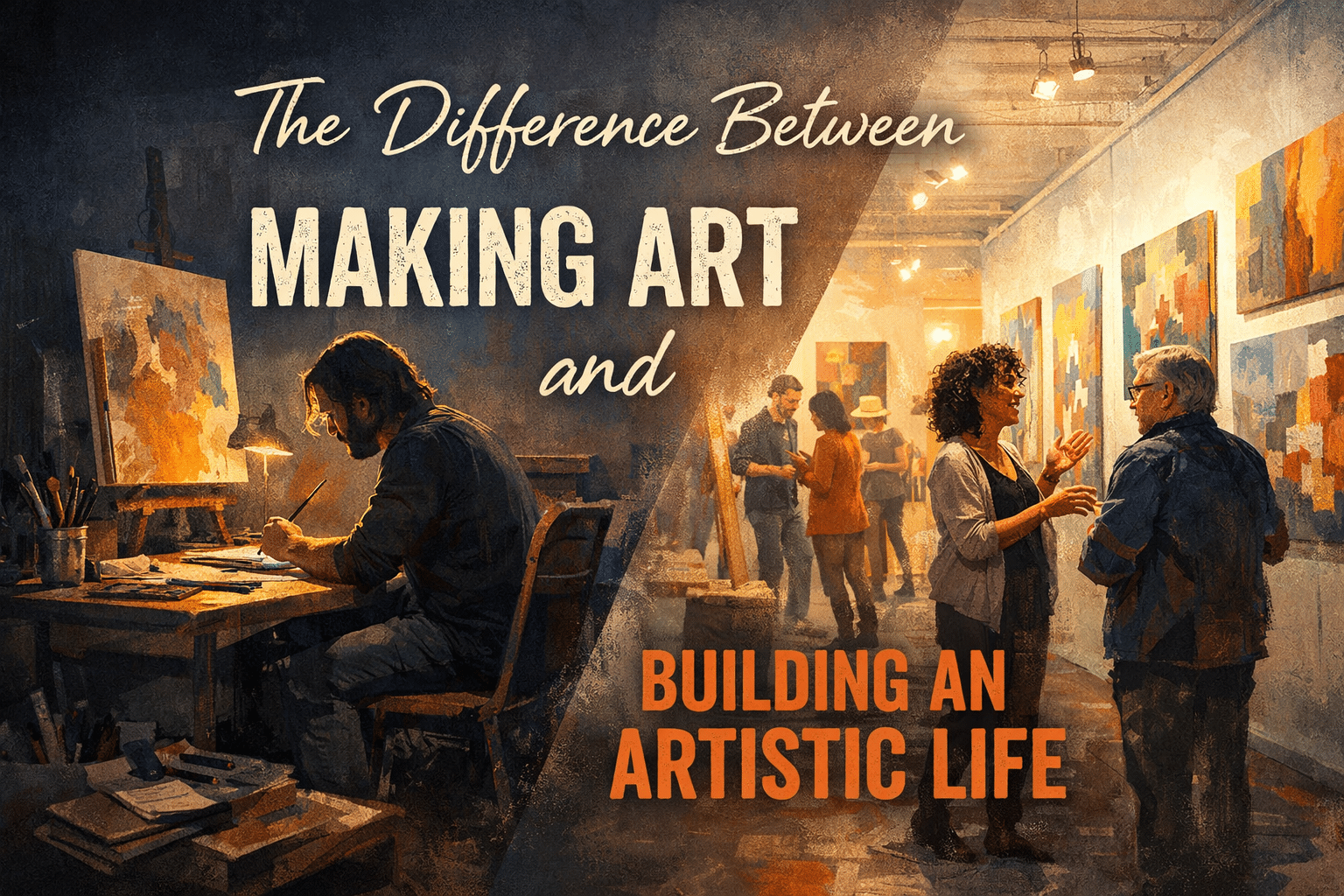
Most artists begin by making art whenever they can find the time.
It happens in the margins of a busy life. Evenings after work. Weekends when other responsibilities are quiet. The work might live on a kitchen table, in a spare room, or wherever space can be cleared long enough to focus. At this stage, there is no larger structure around it. The work exists because the artist feels compelled to make it.
For many people, this is where it stays.
There is nothing wrong with this. Making art for its own sake is meaningful and necessary. But building an artistic life requires something more than the act of creation itself. It requires consistency, visibility, and connection.
One of the first differences is continuity. When artists begin to build an artistic life, the work becomes part of their regular rhythm rather than something they return to only when time allows. They make space for it. They return to unfinished ideas. They begin to see how one piece leads to the next, and how their work evolves over time.
This continuity changes the work. Skills improve. Ideas deepen. Confidence grows, not because every piece succeeds, but because the artist remains engaged long enough to learn from the process.
Another difference is the decision to share the work.
Showing art publicly, whether in an exhibition, a studio, or even a conversation, changes how it exists in the world. It allows others to respond to it, connect with it, and carry it into their own lives. For collectors, this is often where the relationship begins. The work moves from being a private exploration to something that creates meaning beyond the artist’s own experience.
Collectors are not only drawn to individual works, but to the progression behind them. They see how an artist’s ideas develop over time. They recognize commitment. They witness growth. This continuity gives the work context and depth.
Building an artistic life also means becoming part of a larger creative environment. Artists learn from one another. They exchange ideas, share techniques, and offer encouragement during periods of uncertainty. This environment helps sustain momentum, especially during times when motivation is difficult to maintain alone.
Over time, these elements begin to reinforce one another. The artist makes more work. The work improves. It reaches more people. Opportunities emerge. What once existed in isolation becomes part of an ongoing path.
From the outside, this transformation can appear gradual, but its effects are lasting. The artist develops not only a body of work, but a body of experience. Each piece becomes part of a larger story.
This is the difference between making art and building an artistic life.
Making art is where it begins. Building an artistic life is what happens when the artist continues.
It is not defined by a single moment of success, but by the decision to remain engaged, to keep exploring, and to allow the work to grow over time.
For artists, this process brings clarity and direction. For collectors, it creates the opportunity to connect with work that reflects not just a single idea, but an evolving vision.
Both are part of the same journey.